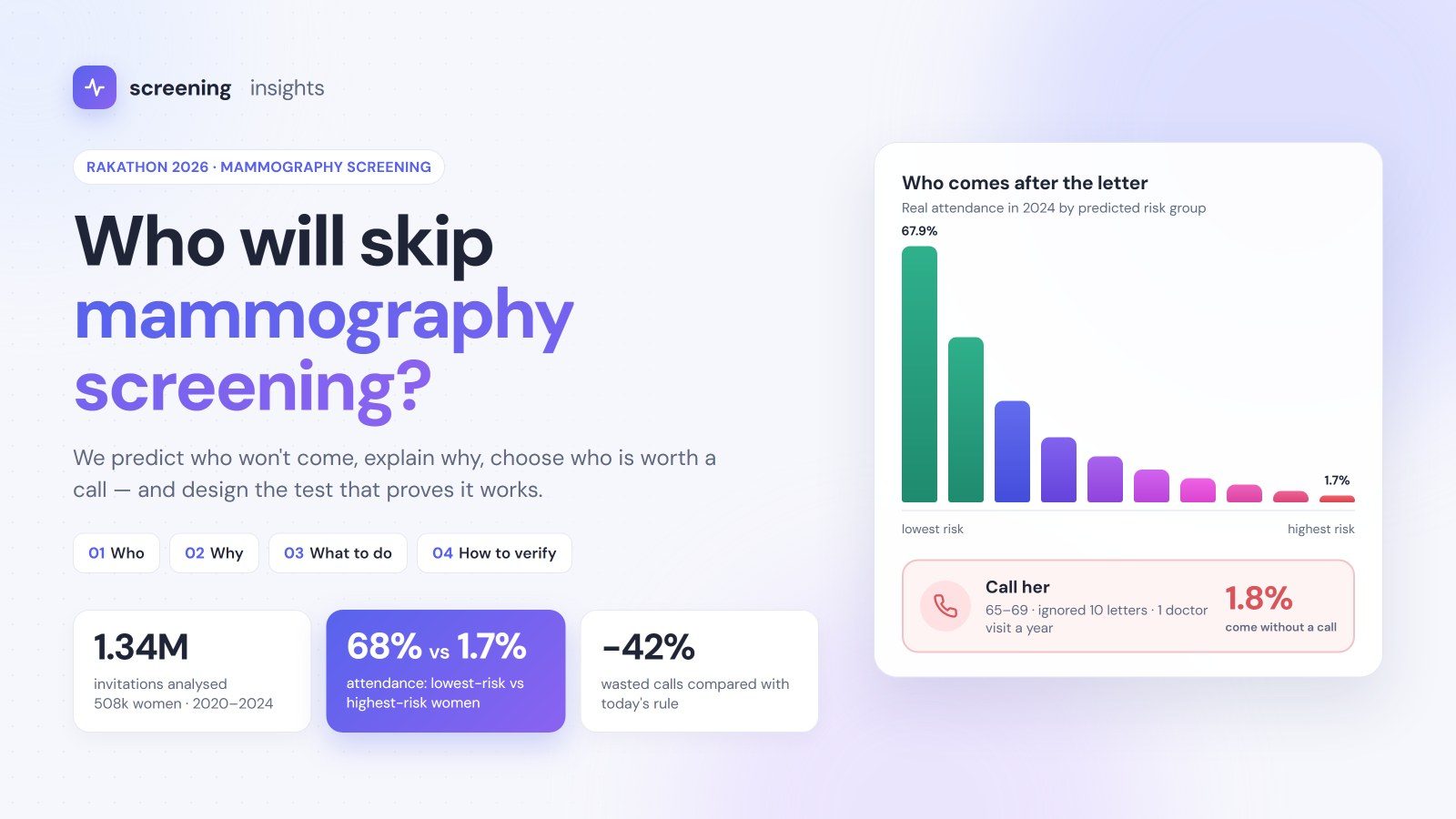
Built an ML solution to predict missed mammography appointments, segment risk, and recommend interventions to improve screening attendance.
Screening Insights is a decision-support prototype for VZP’s mammography invitation programme. It combines data preparation, automated model selection, risk prediction, model explanations and an interactive React dashboard. Data The dataset contains 1,344,556 invitations for 508,527 women from 2020–2024. Each row represents one invitation, so the same woman can appear in several years. The supplied cohort consists of women continuously insured with VZP from 2015 to 2025. The records describe invitation history, previous screening, preventive visits, healthcare contacts, age groups, territorial offices and registration with a general practitioner or gynaecologist. They also contain screening indicators for 3, 6 and 12 months after the invitation. The primary modelling target is non-attendance within 12 months. Post-invitation screening indicators are used to define or analyse outcomes, never as predictive inputs. Personal identifiers are used for grouping records and validation, not as model features. Methods The Python pipeline maps source columns into a consistent schema, handles missing values and checks for duplicates, inconsistent records and potential information leakage. Features describe information available at the time of invitation. We train on earlier years and reserve 2024 as a separate test period. During model development, cross-validation groups records by woman to avoid placing the same person in both training and validation folds. FLAML searches across model families and configurations. Optuna further tunes LightGBM using early stopping and pruning. Candidates are compared on the same validation folds before the final model is evaluated on the held-out year. Evaluation includes ROC-AUC, Average Precision, calibration, Brier score and performance at different contact-list sizes. SHAP or permutation importance explains which features influence predictions. Rule-based segments connect recorded histories to proposed outreach approaches. Experiments and model configurations are tracked in MLflow. The trained model is saved with its feature schema, while the React dashboard reads aggregate reports rather than individual patient records. Next steps We will confirm field definitions, invitation eligibility rules and the applicability of the supplied cohort with VZP. We will also establish which contact channels, staff capacity and actual costs are available. The next development stage is a pre-specified A/B test: define one audience and one intervention, calculate the required sample size, randomly assign women to the usual invitation or additional support, and follow screening participation. Later iterations can use experimental data to estimate who benefits from particular interventions, alongside monitoring data quality, calibration and performance across groups.
- Had before
- A strong motivation to deliver high quality project.
And a based knowledge in the area of implementation. - Use of AI
- We used Claude and Codex for coding, debugging, testing, and dashboard design. We checked AI-generated code and claims against the source data and code logic, computed reports, and automated tests.
- Impact
- The project can help VZP focus support where it may be needed, increase screening participation and use outreach resources more efficiently. It also provides a clear way to test which interventions work before expanding them.
- Who benefits
- Patients and their families, Health insurers
- InterSystems technologies
- No
- Team
- Titics — Andrii Shudrak, Bohdan Nesterenko
- Challenge
- From invitation to mammogram · Prague