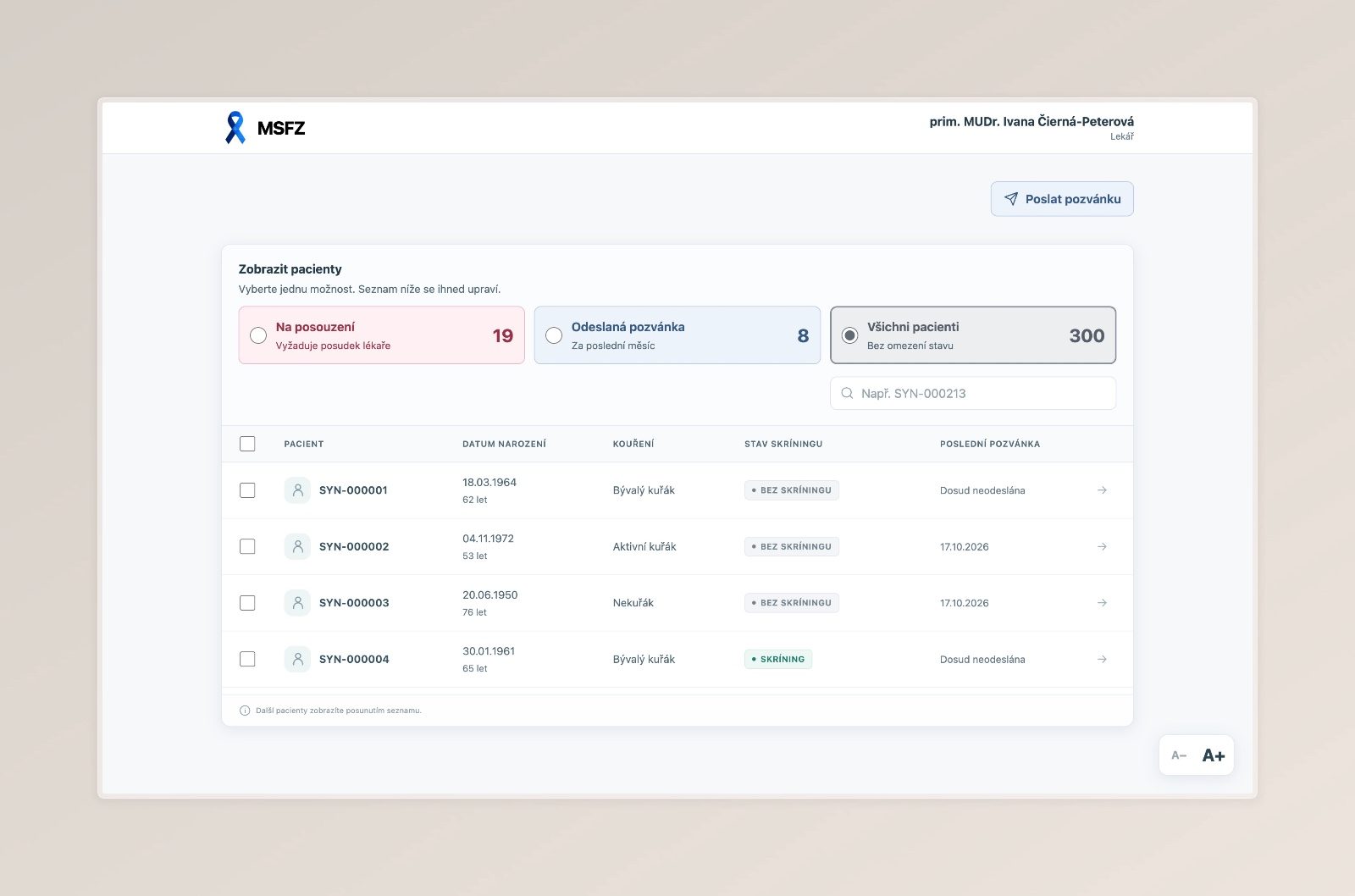
An intuitive system for GPs that enables the automated management of invitations to lung screening.
Our website helps healthcare professionals identify and contact patients for lung cancer screening. It brings together, in one place, an overview of patients, their smoking history, records of previous CT scans and a history of invitations sent. The aim is to simplify the selection of patients to be invited and to reduce the need to manually review individual records. Based on pre-set rules, the application assesses age, smoking status, available information on previous CT scans and the most recent invitation sent. It categorises patients as suitable for invitation, requiring assessment, or currently not meeting the criteria. It displays, in detail, the reasons for classification and the basis for the healthcare professional’s decision. Users can search for patients by ID, filter results, select patients individually or in bulk, and prepare invitations. The system recommends a communication channel based on the patient’s preferred method and available contact details; users can change this. We worked with mock data provided, i.e. synthetic records, rather than real patient data. The dataset contained 300 patients, 300 smoking history records, 140 CT scans and 100 contact history records. This data enabled us to verify the linking of information and the application’s behaviour in cases of incomplete or ambiguous records. During the hackathon, we created a working prototype with a web interface, backend and database. We managed to implement data import and linking, automatic evaluation according to the prototype’s rules, patient overviews and details, filtering, bulk selection and the tracking of invitations. We also added email sending and a test SMS integration. For postal invitations, the application currently records the request. The result is an integrated process ranging from locating a patient, through checking their records, to contacting them. We have added the names and contact details of the nearest pulmonology practices, based on the patient’s place of residence, to the message template. The next step would be to incorporate the results of screening images and the subsequent flagging of patients based on the findings. We would also add attendance tracking, flagging of patients who did not attend the examination, and the option to contact them again. The application would thus monitor the entire screening process from the invitation to the result. In the future, the solution could be extended to other screening programmes with their own rules and intervals. For real-world deployment, this would be followed by verification of the rules with experts, integration with healthcare systems, and the implementation of login and access permissions.
- Had before
- Nic.
- Use of AI
- AI nevyužíváme, projekt vyžaduje pouze využití zavedených zdravotnických standardů.
- Impact
- Projekt může ušetřit čas lékařům a sestrám tím, že propojí informace o pacientech, usnadní výběr vhodných osob pro screening a zajistí jejich automatické oslovení bez nutnosti zásahu lékaře. Zdravotníci tak mohou věnovat více času péči o pacienty a méně administrativě.
Systematické oslovování může zvýšit účast na screeningu a podpořit včasnější odhalení onemocnění. Automatický systém odhalí všechny pacienty a zabrání případné lidské chybě. Přehled předchozích vyšetření a pozvánek zároveň pomáhá omezit zbytečné opakované kontaktování a účelněji využívat kapacity zdravotnictví.
Po doplnění výsledků vyšetření a evidence neúčasti by aplikace usnadnila i kontrolu lékaře nad stavem pacienta. Do budoucna lze stejný princip využít také pro další screeningové programy. - Who benefits
- Doctors and nurses
- InterSystems technologies
- No
Machine translation from Czech
- Team
- MSFZ — Marianna Zapotoková, Lenka Šustrová, Alex Marinica, Timothy Ján Fecko
- Challenge
- Path to lung cancer screening · Prague