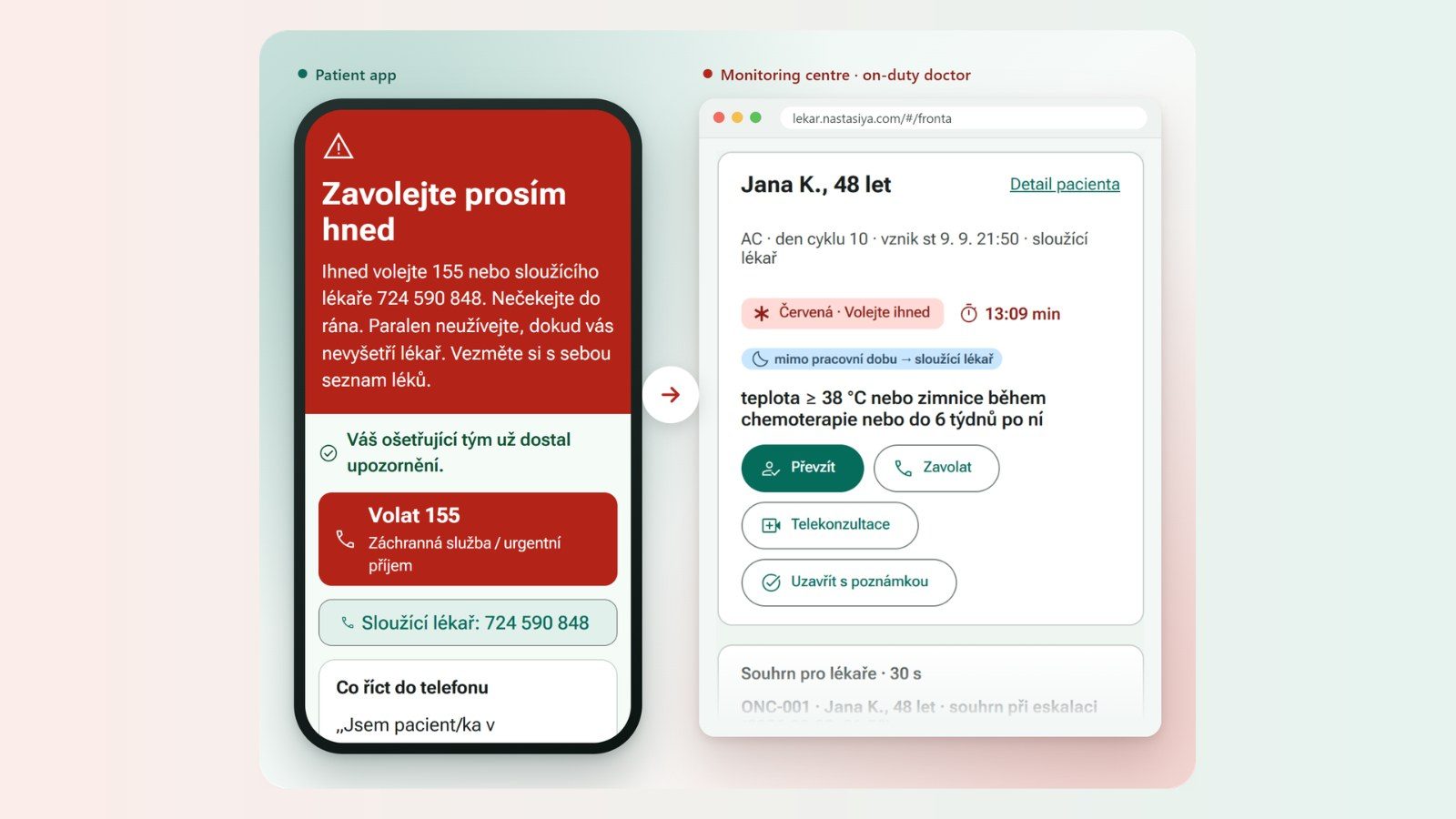
AI navigator for cancer patients between visits: a safe next step for the patient, a timely alert and a 30-second summary for the doctor
Between visits, a patient on cancer treatment often feels unwell and does not know whether it can wait until morning. MEDDI Onco judges each questionnaire answer on its own; our navigator looks at the whole situation.
How it works
- The patient (or a relative in caregiver mode) fills in a short check-in tailored to the treatment, or writes to the AI chat, in Czech or Slovak.
- 49 deterministic medical rules read the answers together with the treatment (chemo nadir, drug classes), the trend of earlier days and the free text. The AI only extracts quoted facts from the text and can only raise the level, never lower it.
- The patient gets one of four colours with one clear step and the right phone number. No diagnosis, no dose changes.
- The monitoring centre or the on-duty doctor gets a task with a countdown (15 min for red) and a 30-second summary: why now, treatment, trend, labs.
- Push reminders for check-ins and team messages; the patient app installs on phones and tablets as a PWA.
Data The synthetic MEDDI Onco challenge data: 14 dev patients and 100 extended patients, 1,320 check-ins with ground truth, the triage rules and questionnaires.
What we built
- Patient PWA (React) and clinician web: queue with SLA timers, patient detail, monitoring, rules, notifications
- FastAPI backend: triage engine, navigator chat with guardrails, evaluation
- InterSystems IRIS for Health: every record stored as FHIR R4, SQL over FHIR for trends, Vector Search for the chat, an interoperability production that takes HL7v2 labs in and sends alerts out to a proposed MEDDI endpoint; MCP server for AI agents
- Had before
- Nothing. Everything was built during the hackathon on the MEDDI Onco challenge data, using open-source libraries (React, FastAPI, Material Web) and InterSystems IRIS for Health Community
- Use of AI
- LLM (OpenAI) in two narrow roles: it extracts quoted facts from the patient's free text in Czech/Slovak (closed fact list, every fact must quote the patient's words), and it writes the chat answers. The triage level is never set by AI: 49 deterministic rules from the MEDDI triage guidelines decide, and LLM facts can only raise the level, never lower it. Chat answers go through guardrails and a validator (no diagnosis, no dose changes, correct phone numbers) with a safe template as fallback. IRIS Vector Search finds the relevant guidance for the chat; an MCP server gives AI agents read-only access to the data in IRIS.
- Impact
- Patients get one clear, safe step at any hour instead of guessing whether a symptom can wait. The care team sees who needs help first: each alert comes with a countdown (15 min for red) and a 30-second summary, so a nurse does not have to read the whole history. Dangerous situations that single answers miss (fever in the chemo nadir, weight gain on cardiotoxic drugs, a message contradicting the form) are caught on the same day: in our replay every red case was caught and no patient was under-triaged, while only about 3 % of harmless check-ins reached the team (target 15 %). Estimate: a few minutes saved per alert for the monitoring centre and fewer emergency admissions thanks to earlier calls. Built on FHIR in InterSystems IRIS, it plugs into hospital systems and MEDDI through one endpoint.
- Who benefits
- Patients and their families, Doctors and nurses, Hospitals and care providers
- InterSystems technologies
- Yes — Every record lives as FHIR R4 in IRIS for Health: patients, check-ins, triage results, tasks and alerts. We read trends with SQL over the FHIR data, the chat finds guidance with IRIS Vector Search, and an interoperability production brings HL7v2 labs in (HL7 to SDA3 to FHIR) and sends every alert to a proposed MEDDI endpoint. An MCP server gives AI agents read-only access to the data in IRIS and function calling
- Team
- Data Team — Danil Tkachenko, Anastassiya Pavlova
- Challenge
- MEDDI ONCO Challenge · Prague