API for matching patients and clinical trials: FHIR, InterSystems and citations from medical reports; the doctor has the final say.
AI Trial Matching
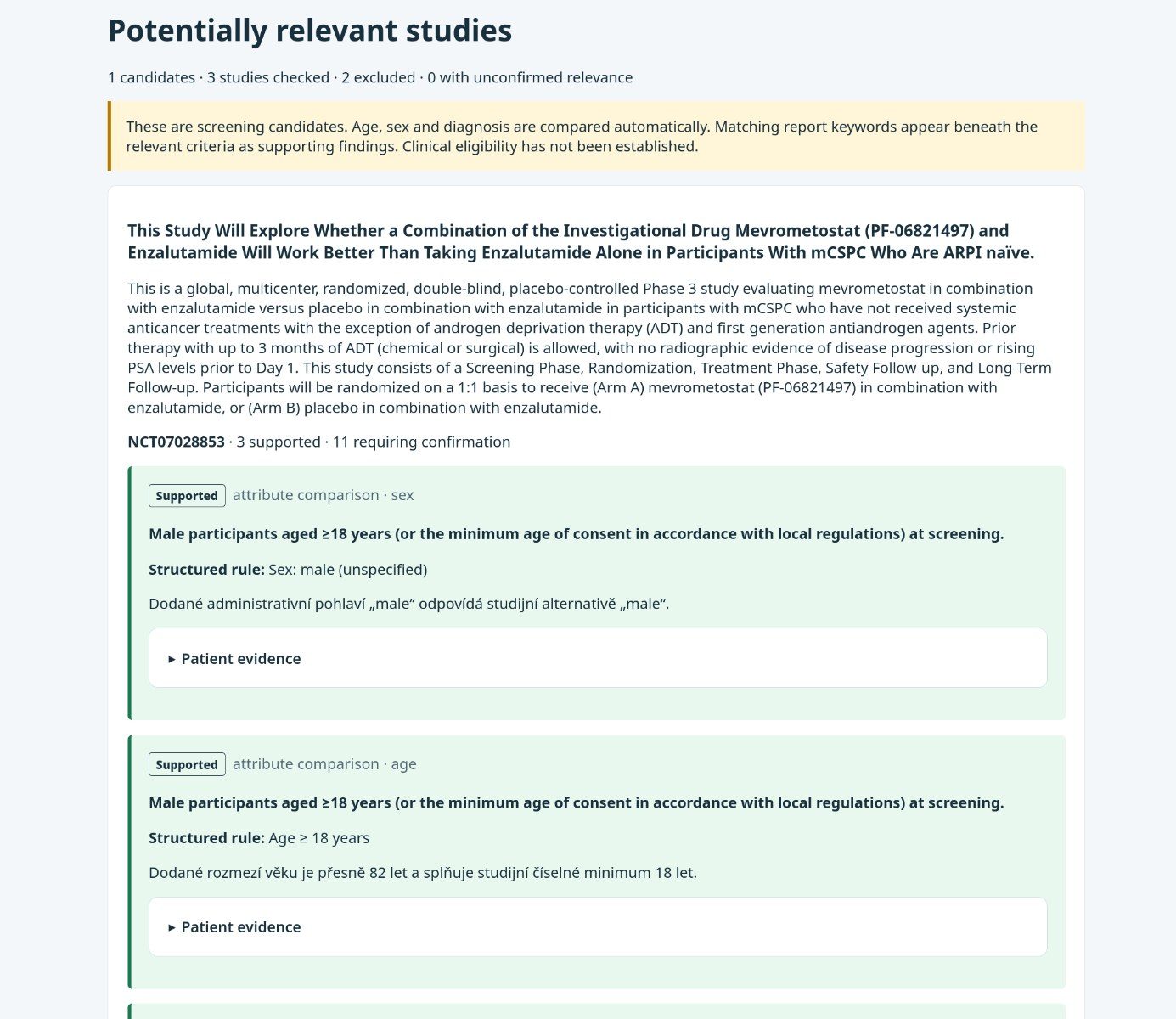
Our API for the pre-selection of oncology trials returns candidate trials and the supporting documentation required for their assessment. By integrating it into hospital software, doctors can access the results within their own system without needing a separate application. The accompanying UI is a layer built on top of the API.
From documentation to an interpretable result
- Patient profile. By making maximum use of structured data from the patient’s FHIR file, we deterministically extract age or age range, administrative gender and diagnoses, including codes and clinical status.
- Structuring clinical trials. We retrieve trials based on the NCT identifier from the global ClinicalTrials.gov registry. The LLM converts textual requirements into structured inclusion and exclusion criteria.
- Quotations from medical reports. The LLM prepares Czech and English regex patterns for specialist terms, abbreviations and codes to match the study criteria. These patterns are used to search locally for relevant passages in patient reports. For each specific inclusion or exclusion criterion, we return an exact quotation from the medical report, along with the document and date. The doctor receives specific text for verification, not just a score.
- Structured comparison. We record patient profiles and study rules in validated FHIR files with links to the original sources. The LLM compares age, gender and diagnosis within the context of the study and explains any agreement, discrepancy or need for verification. It works with selected attributes, not entire reports. Citations from medical reports supplement the evidence for assessing other criteria.
InterSystems and deployment
We support HL7 FHIR R4 and R5, which facilitates integration with systems using different versions of the standard. InterSystems IRIS for Health provides a persistent repository for approved studies. Once a study has been processed, we can use it for other patients; the catalogue simply needs to be expanded and updated. The planned regional search function will utilise the study locations stored in the database.
The working solution runs in the included Docker Compose file: an API with a UI, IRIS and an HTTPS proxy with persistent data. It is ready for pilot deployment within a matter of days following the configuration of access rights, the LLM endpoint and security.
Results and explainability
We evaluated the Luna, Sol and DeepSeek models and reasoning modes both quantitatively and qualitatively, with an emphasis on explainability: detection, latency, reasoning and its support in the data. Luna default and Sol default produced identical decisions; Luna had a median latency of 4.78 s compared to 15.27 s. We therefore selected Luna for the pilot.
In the retrospective pilot test, we evaluated 7 pairs of patients and studies involving 7 patients identified in medical reports. The result was 6/7 (85.7 per cent): six matches and one discrepancy between breast and ovarian diagnoses. Any potential link to metastases is assessed by a doctor. Furthermore, the qualitative evaluation highlighted the need to distinguish between clinical and administrative sex; such uncertainty is not automatically a fault of the model.
The doctor approves the study criteria and has the final say on patient inclusion. We provide them with a shortlist and verifiable supporting documentation directly within their workflow.
- Had before
- Nic
- Use of AI
- Na analýzu textových dat se používá model gpt-6-luna, kontroluje se vzájemně se standardizovanými daty z FHIR souborů. Když ne, uvede to lékaři kontext z lékařských zpráv a odůvodnění, proč se rozhodl agent jak se rozhodl. Celý systém je plně kontejnerizován a připraven k okamžitému nasazení.
- Impact
- Ušetří čas doktrům, hledajícím nové klinické studie, a studie vhodné pro jejich pacienty. Samo to ověří základní kritéria, která by pacienta ze studie vyřadily. Projde lékařské zprávy pacienta, a najde úryvky o diagnózách a vyšetřeních, které jsou relevantní pro studii, a navrhne podle nich, zda pacient na studii sedí.
- Who benefits
- Patients and their families, Doctors and nurses, Hospitals and care providers
- InterSystems technologies
- Yes — Používáme pacientská FHIR data, a data o klinických studiích také ve FHIR formátu. Zpracované přidané informace uládáme také ve FHIR formátu.
Machine translation from Czech
- Team
- Pixel Predators — Filip Oliver Klimoszek, Jan Hlavsa, Barbora Čurdová, Michal Mrkos
- Challenge
- AI Trial Matching · Prague