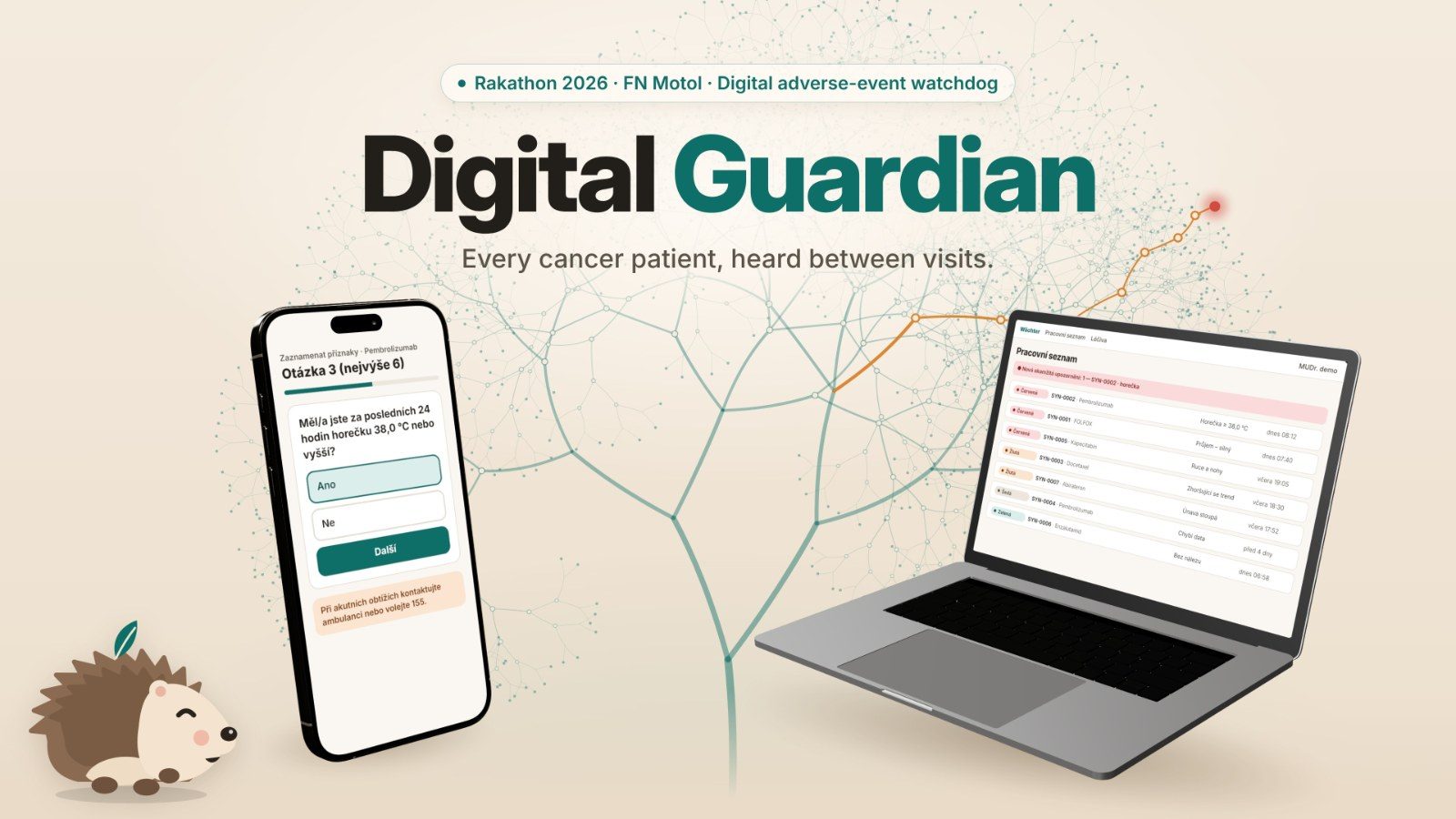
Cancer patients report symptoms daily; explainable AI-assisted triage alerts the clinic to serious side effects, not every minor one.
Between two oncology visits, side effects often reach the clinic too late. Digitální hlídač closes that gap: patients are heard between visits, and the clinical team learns immediately about serious adverse effects – not about every minor thing, exactly as FN Motol asked.
For the patient (Czech/English, on the phone): a short check-in tailored to the current therapy, one question per card, in the official PRO-CTCAE wording (NCI registration pending). It stops as soon as the result can no longer change: about 5–6 questions instead of 14–17. Afterwards the patient gets practical, rule-based tips per symptom. In acute situations the clinic's instruction comes first: contact the outpatient clinic or call 155.
For the doctor: prepared before every visit, with a work list ranked by urgency and a patient cockpit showing the history since the last visit and an AI summary in which every sentence links to its source. Few, meaningful notifications: only red alerts notify at once, a noise brake keeps repeats quiet while any worsening still gets through, and safety floors such as "fever means red" are locked. Every alert explains itself in one click: rule, threshold, values, evidence and what would change the level. Acknowledgement and CTCAE v6 grading stay with the physician. Doctors can also search drugs by name, SÚKL code or ATC, and import clinical documents with AI (proof of concept): facts are extracted with their quote and become HL7 FHIR R4 drafts that the doctor confirms.
The core is a verified decision tree. Clinicians write the rules; we compile them into a decision tree per therapy and check it against every combination of answers – up to two million per profile – with zero under- and zero over-triage, also in 20,000 simulated check-ins across 8 therapy profiles. This verifies faithful implementation; the clinical thresholds are placeholders until FN Motol reviews them.
Integration: every patient exports as an HL7 FHIR R4 bundle with zero HAPI validator errors, also as a transaction bundle in the InterSystems kit format, ready for IRIS for Health.
Built to grow: new drugs and diagnoses plug in as verified modules. Next comes our own model trained on anonymised outcomes, held to the same checks – never less safe than the clinicians' rules. The prototype runs on synthetic data only.
- Had before
- Before the Rakathon we set up our own team of AI agents and wrote the rules they work by. A0 is the lead: it plans the architecture, hands out the work and is the only one allowed to merge into main. A1 takes care of evidence and clinical safety, A2 writes the code (two of them in parallel), A3 checks everything independently, including security, and A4 does the pitch and the demo.
- Use of AI
- AI does the heavy lifting, under control. It extracts the relevant facts from clinical documents and drug labels and turns them into HL7 FHIR R4. It drafts a short patient summary for the physician. The compiled decision tree adapts the questionnaire so patients answer only what matters.
Why not just an LLM? A plain chatbot can hallucinate, give different answers to the same data and may store or train on what it sees. Ours runs in the EU data zone with storage off, sees only the facts it needs, and must back every sentence with a source – a deterministic checker removes anything unproven, and a template takes over if the model is unavailable. Alert levels come only from verified, explainable rules, and the physician always decides. The design follows the EU AI Act principles for high-risk systems: human oversight, transparency, logging and data minimisation. - Impact
- Patients are heard every day instead of every two to three weeks, and they answer only a handful of questions. Clinicians start the day knowing who needs them and why, with documentation already in HL7 FHIR for the hospital system.
The approach is backed by evidence: in a randomized trial of 766 patients (Basch et al., JCO 2016 / JAMA 2017), regular electronic symptom reporting went with fewer emergency visits (34 % vs 41 %) and longer median survival (31.2 vs 26.0 months).
The system is built to grow with the clinic. The decision tree takes new drugs and diagnoses without rewriting code, and every new version is verified before use. Next steps: clinical review of thresholds and tips with FN Motol, a live link to InterSystems IRIS for Health, drug-class modules and a pilot. In the long term, anonymised outcomes will let the tree learn patterns that experts have not yet described – without ever becoming less safe than the clinicians' rules. - Who benefits
- Patients and their families, Doctors and nurses, Research
- InterSystems technologies
- Yes — Every patient record is exported as a validated HL7 FHIR R4 bundle (patient, ICD-10 diagnosis, therapy, check-ins, alerts, CTCAE grades, AI summary with provenance) with zero HAPI validator errors. A transaction bundle in the InterSystems kit format can be pushed to IRIS for Health. AI-assisted import turns facts from clinical documents and drug labels into source-linked FHIR resources, approved by the physician.
- Team
- Junior Scholars — Hlieb Marchenko, Lenny Kranjec
- Challenge
- Digital adverse-event watchdog · Prague