We identify clusters of female patients, recommend appropriate measures to increase screening attendance, and propose more effective communication strategies.
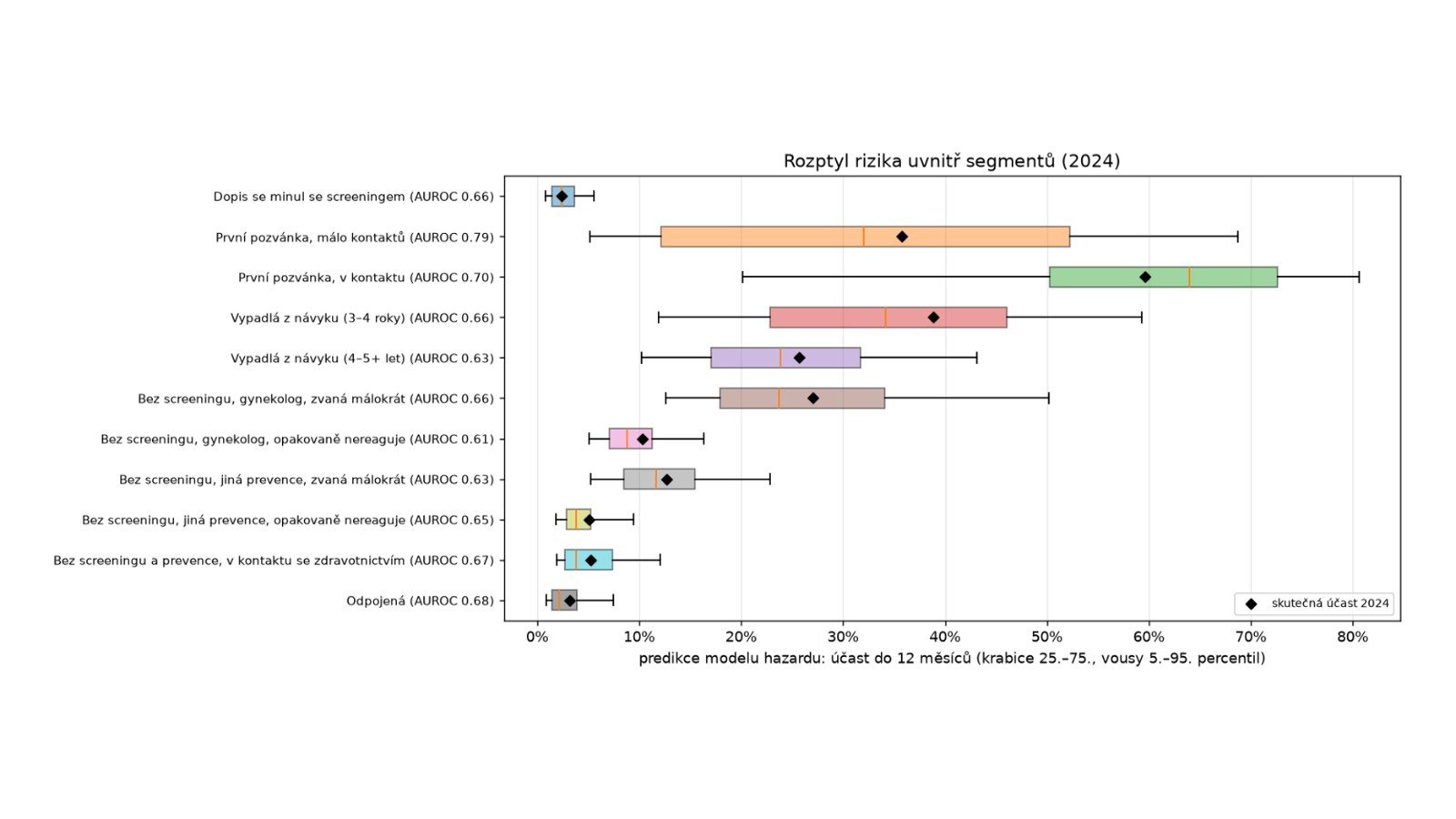
Every year, VZP sends tens of thousands of letters to women who do not attend their mammograms. In 2024, out of 256,000 women invited, 207,000 did not attend. Nearly half of them had already received their eighth or subsequent invitation, and 7,600 letters a year are sent to women who had a screening just a few weeks earlier. Women who have never attended a screening are twenty times more likely to have stage IV cancer than those who attend regularly (15.5 per cent versus 0.7 per cent). These women are in the system; we simply keep contacting them in the same way, even though the letters have long since ceased to have any effect on them. We have therefore built a machine learning (ML) model based on 1.34 million invitations from 2020–2024, which, with an AUC of 0.83, predicts who will not attend after receiving an invitation and, crucially, explains why. The most significant finding: as women age, gynaecologists – who are currently the main gateway to mammograms – disappear from their care pathway. The GP, whom women continue to see, clearly does not refer them for mammograms, and gynaecologists do not receive a single crown for their patients’ participation. From the data, we derived 11 clear-cut segments based on simple rules, which VZP can calculate in SQL or Excel without the need for new IT systems. The segments themselves rank women almost as effectively as a machine learning model (AUC 0.80); they have remained stable for five years, and without intervention, women do not return to the system on their own. Key finding: 59 per cent of women who did not attend are still within the healthcare system. They visit a gynaecologist, a GP or attend other screening appointments. They can be reached, just by a different means than a letter in the postbox. For each segment, we have identified measures with proven effectiveness from the literature and interviews with experts: a fixed appointment rather than an open invitation, an earlier reminder for women who have missed their appointment, or transport in districts without a mammography unit. ‘What-if’ scenarios demonstrate the power of these measures. If GPs recommended mammograms in the same way as gynaecologists, this would result in, at the upper end of the estimate, up to 34,000 additional screenings and over 190 cases of cancer detected at an early stage each year. Resolving transport issues in districts without screening centres would yield an effect roughly three times smaller but more targeted for women aged 65 and over. By implementing these measures, we would save hundreds of millions of CZK a year on treatment costs. We also propose a module integrated into the VZP system that streamlines outreach: a digital cascade of push notifications, emails and RCS messages, triggered by VZP data, with messages sent on behalf of the registering doctor and the screening process itself concluded by the mammography centre. One campaign wave costs 3.36 CZK per woman, compared with 40 CZK per letter, so it reaches 3.5 times as many women at 38 per cent of the current cost of letters. The doctor can see who the programme has contacted, who has attended, and what VZP will pay them for this. At the same time, we propose personalising the communication and tailoring the content to each segment so that it better addresses the needs and concerns of these women. The financial model for 2027–2031 projects, in the baseline scenario, approximately 291,000 additional screenings, 1,600 tumours detected at an early stage, approximately 190 deaths averted and net savings of 156 million CZK (range 86–237 million). We propose a randomised pilot study, with pre-registration and results measured directly from VZP’s reported service data. We will hand over the model, segments and experiment, including the code and documentation. The actual implementation of the first measures can take place within a matter of weeks, and we would be happy to contribute to their implementation.
- Had before
- otevřená data
- Use of AI
- AI používáme ve třech vrstvách. Zaprvé strojové učení na datech VZP: model CatBoost odhaduje pro každou pozvánku šanci, že žena přijde na mamograf do 3, 6 a 12 měsíců (AUC 0,84 na roce 2024), metoda SHAP ukazuje proč, a z výsledků jsme odvodili 11 srozumitelných segmentů. Pro provoz navrhujeme vysvětlitelný model účasti (EBM) a model upliftu, který se z randomizovaných pokusů učí, komu která intervence skutečně pomůže. Zadruhé jazykové modely pro obsah: varianty dopisů a SMS pro jednotlivé segmenty, jen ze schválených faktů a s kontrolou zdravotním garantem; účinek variant ověřujeme experimentem. Zatřetí AI asistenty v týmu: rešerše literatury, programování analýz a příprava podkladů, díky nimž jsme za hackathon zvládli data, model, segmentaci i návrh experimentu. AI nerozhoduje o péči: navrhuje, koho a jak oslovit, rozhodují lidé a výsledek měříme vykázanými výkony.
- Impact
- Projekt pomůže VZP oslovit správné ženy správným kanálem. V roce 2024 nepřišlo po pozvánce na mamograf 207 tisíc žen; 59 % z nich přitom chodí ke gynekologovi nebo na jinou prevenci, takže jsou dosažitelné přes lékaře. Chytřejší zvaní samo ušetří ročně asi 7 600 zbytečných dopisů ženám těsně po vyšetření. Předrezervovaný termín pro první pozvánky a vypadlé ženy může přinést 6,5–12,5 tisíce mamografií navíc ročně, zapojení gynekologů a praktiků dalších 3–8 tisíc. Podle finančního modelu to za roky 2027–2031 znamená zhruba 1 600 nádorů zachycených v časnějším stadiu, asi 190 odvrácených úmrtí a čistou úsporu 86–237 mil. Kč. Každé opatření ověříme randomizovaným experimentem proti dnešnímu dopisu, takže VZP bude rozšiřovat jen to, co prokazatelně funguje.
- Who benefits
- Patients and their families, Doctors and nurses, Health insurers
- InterSystems technologies
- No
Machine translation from Czech
- Team
- Mámo, graf! — jakub@weiner.cz, vit.tucek@gmail.com
- Challenge
- From invitation to mammogram · Brno