An AI tool for oncology: it identifies clinical trials that a patient is eligible to join, and finds patients who can be enrolled in a trial.
Problem:
- Trial coordinators and oncologists manually compare long lists of criteria against the free-text content of Czech medical reports.
- As a result, they either identify a suitable patient too late, or the patient is excluded by a criterion that was present in the documentation all along.
How it works:
- We download oncology trials in the Czech Republic and their criteria from ClinicalTrials.gov. We store them in IRIS in FHIR format: the trial as a ‘ResearchStudy’, and the criteria as a ‘Group’ within it.
- The model converts the criteria into separate Czech rules, each with verbatim citations from the register.
- Numerical limits and time windows are structured fields and are calculated by the code.
- Rules that cannot be verified from the documentation are sent directly for manual assessment.
- From the patient’s record, the model generates a profile: diagnosis, stage, biomarkers, treatment, performance status, comorbidities, medications and laboratory results, all with a date and a reference to the source. The ‘Classification System One’ model then reads only this profile.
- The core of the tool: the Jev model decides on each rule individually. It receives the profile and the rule as a query and returns only the probability of two answers: ‘yes’ or ‘no’. If the profile provides no indication, it assigns equal weight to both. The code from the issue determines the result: ‘yes’, ‘no’, or otherwise ‘unknown’ (i.e. data missing).
- Every definite answer must be supported by evidence; otherwise, it is ‘unknown’. The code verifies that the citation appears verbatim in the document.
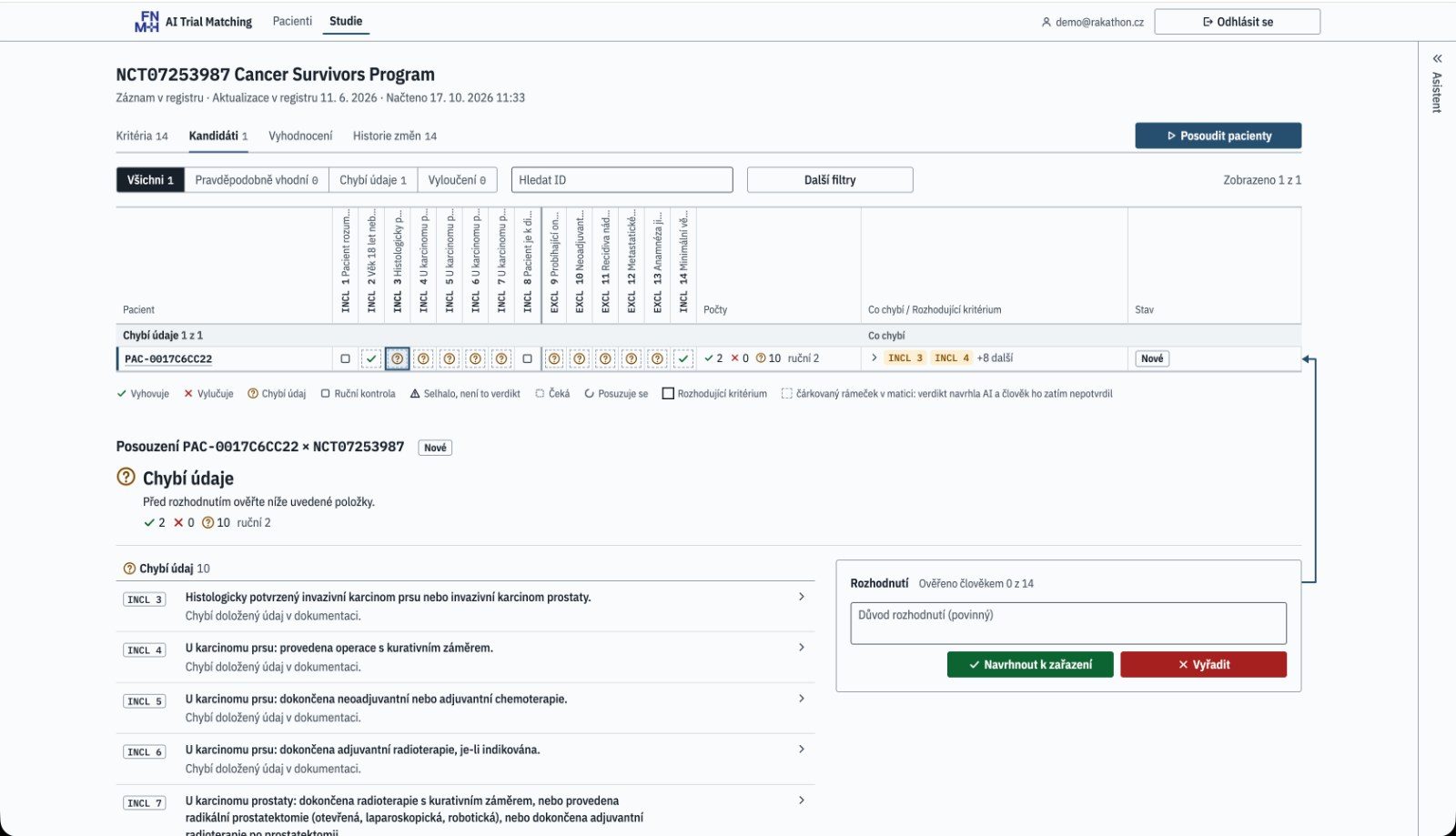
- The coordinator can view the matrix of patients and criteria, the timeline and the details of each pair.
- Searches can be conducted in both directions: from candidates to the study, and from the study to the patient.
- There is an AI assistant on every page. The user selects a study, criterion, patient or verdict with the pointer, and the assistant explains what it sees and how the data are related.
Security:
- Missing patient data is marked as ‘unknown’ and represents a task for the coordinator.
- An excluded patient remains visible, along with the criterion that led to their exclusion.
- We display the numbers of criteria that have been met, not met and are unknown.
Deployment and data:
- The Next.js application is deployed on Vercel.
- The evaluation backend runs as a function on Vercel, with one call per patient-study pair.
- A Supabase auxiliary database stores the screening status, patient profiles and change history.
- The database from the InterSystems challenge, IRIS for Health with FHIR R4, is deployed on Azure. We have loaded sample data into it, which we received from the organisers.
- We call the models via OpenRouter with zero-data-retention.
- Only identifiers and results are logged.
What we’ve achieved:
- Deployed the entire workflow from registration to review by the coordinator, with an audit trail.
Access to the demo
- Email: demo@rakathon.cz
- Password: Winners
- Had before
- Jen rešerši a dokumentaci v Markdownu: rozbor zadání, návrh architektury, bezpečnostní pravidla a návrhy obrazovek. Všechno ostatní vzniklo během hackathonu.
- Use of AI
- - Jev 1.14 od TypeSafe: rozhodovací model. Čte jen redukovaný profil pacienta a pravidlo jako otázku a vrací pouze pravděpodobnost „ano“ a „ne“. Z ní kód určí ano, ne, nebo „neznámo“ (chybí data). Každé pravidlo posoudí zvlášť. Je rychlý a levný, důkaz k odpovědi hledá další model.
- Claude Haiku 5.5: kritéria na pravidla, profil pacienta pro Jev, důkazy v dokumentaci, hledané výrazy pro studie.
- GPT 6.1 Sol: asistent na stránce, který vysvětlí, co uživatel vidí a jak spolu údaje souvisí.
- Data: pseudonymizované záznamy pacientů v IRIS a kritéria studií z ClinicalTrials.gov.
- Jak hlídáme omyly: citace musí stát doslova v uvedeném dokumentu, limity a data počítá kód.
- Neověřitelná kritéria jdou rovnou na ruční posouzení.
- Každý verdikt je návrh AI, rozhoduje člověk a změna se ukládá s důvodem. - Impact
- - Koordinátor kontroluje hotové návrhy s citací a doplňuje to, co je „neznámo“.
- Víc pacientů se dostane k nové léčbě a studie rychleji naberou.
- Nemocnice s FHIR serverem může nástroj napojit přímo na vlastní data. - Who benefits
- Patients and their families, Doctors and nurses, Hospitals and care providers, Health insurers, Research
- InterSystems technologies
- Yes — Pacientská data čteme přes FHIR R4 API z IRIS for Health v Azure, kam jsme nahráli vzorová data od organizátorů. Studie z ClinicalTrials.gov ukládáme jako ResearchStudy, kritéria jako Group uvnitř ní a původní odpověď registru jako Binary. Záznamy pacientů aplikace jen čte. Záznamy studií i ukládá.
Machine translation from Czech
- Team
- Compass Crew — Martin Skala, Michal Dobeš
- Challenge
- AI Trial Matching · Prague